
Top Signs You Need Garage Door Service – Don’t Ignore These
The clearest sign you need garage door service is a door that behaves differently than it did a few months ago: slower, louder, jerky, or stopping short. Those small changes are how failing springs, worn rollers, and strained openers announce themselves before they break. Most homeowners read them as quirks and wait. If you’d rather not spend your weekend guessing at hardware, call (866) 488-2820 and we’ll tell you what’s worth checking.
A garage door that takes two seconds longer to open than it did six months ago isn’t “getting old.” It’s a measurable sign of spring fatigue or opener strain, and left alone it usually ends in a snapped spring or a snapped cable. We’d like you to catch it earlier than that.
Key Takeaways
- Slow, jerky movement usually points to spring tension loss, not a tired motor.
- Grinding and squealing are almost always rollers, hinges, or dried-out tracks.
- A door that reverses before closing is a safety sensor or limit switch problem, and it won’t fix itself.
- The 30-second balance test tells you more about your springs than any visual check.
- Some symptoms mean call today. Others can wait two weeks. We break that down below.
Why does my garage door open more slowly than it used to?
Slow operation is the most misread symptom on any garage door. When a door drags or takes longer to travel, the cause is usually one of two things: the torsion or extension springs have lost tension and can no longer counterbalance the door’s weight, or the opener is straining to lift a door that’s fighting it. The motor isn’t getting weaker. It’s working harder.
Here’s the sequence we see in Clearwater. Springs lose a little tension, the door gets heavier, the opener compensates, and within a couple of months the opener’s gear or drive assembly starts wearing at an accelerated rate. What began as one spring problem becomes a spring problem plus an opener problem. That’s why a door that “just feels sluggish” deserves attention now rather than at the next service.
How to tell which one it is
- Door is stiff when you disengage the opener and lift it by hand: spring tension loss.
- Door moves easily by hand but the opener labors: opener strain, drive wear, or a problem with the motor’s force settings.
- Door moves slowly and unevenly, tilting as it rises: one spring is weaker than the other, a classic matched-pair failure.
If you’ve got a LiftMaster or Chamberlain opener on the ceiling, its force settings and travel limits are worth checking, but only after the door’s balance is confirmed. Setting an opener to push harder through a heavy door just moves the failure somewhere else.
What does a grinding or squealing garage door actually mean?
Noise is the garage door telling you where the wear is. A grinding sound during travel usually means worn steel rollers have flat-spotted and are dragging against the track, or the track itself has bent and the roller is scraping its edge. Squealing and squeaking point to dried-out hinges, rollers, and torsion hardware that have lost lubrication. A single loud pop from overhead, followed by the door refusing to lift, is a broken spring and needs a technician, not a can of lubricant.
The common noise map
- Grinding, low and constant: worn rollers or a misaligned track.
- High-pitched squeal: dry hinges, dry rollers, or a dry torsion tube.
- Rattling over the top of the door: loose hinge bolts or a loose opener rail.
- Banging when the door hits the floor: travel limits set too low, or a worn bottom seal.
Clearwater’s humid summers dry out lubricant faster than most homeowners expect, so hinges and rollers that were quiet in spring can start complaining by mid-summer. A quick visual pass along the track and hinges every few months catches most of it. What you shouldn’t do is chase a grinding noise with grease alone; if a roller has physically failed, lubrication just quiets the symptom for a week.
If the noise is coming from the opener itself rather than the door, that’s a different job, and our garage door opener repair page covers the diagnosis in detail.
Why does my garage door reverse before it closes?
A door that reverses before it reaches the floor is almost always a safety sensor or limit switch issue, and it will not resolve with time. Modern openers use two photo-eye sensors mounted near the floor on either side of the opening. If they’re misaligned, dusty, or the sun is hitting one of them directly, the opener reads an obstruction and reverses. That’s the safety system doing its job. The problem is when it’s doing it because of a dirty lens rather than a real obstruction.
What to check before calling
- Are both sensor lenses clean and pointed at each other? A single smudge or a spiderweb is enough.
- Is anything in the door’s path, including a broom handle or a stray leaf that’s landed on the sensor lens?
- Does the door close fine when you hold the wall button down? That points to a sensor problem, not a mechanical one.
- Does the door travel unevenly before reversing? That points to a limit switch or track problem instead.
If you’ve cleaned the lenses and the door still reverses, the issue is in the wiring, the sensor itself, or the opener’s logic board. On a Genie or LiftMaster unit, the diagnostic light on the motor head will flash a code that identifies the fault, and that’s the point where a technician’s read of it saves time. A door that reverses is one that either won’t secure your home or will close on something. Neither is worth living with.
What else should you inspect in Clearwater’s climate?
Clearwater’s humidity does more slow damage to garage door hardware than most homeowners realize, and it makes visual inspection more important here than in drier parts of the country. What you’re looking for is rust and corrosion in its early form: orange-brown dust around hinge pin joints, flaking paint on the bottom panel’s edge, a chalky white film on the torsion springs, or rollers that have seized and stopped spinning freely. Those are the signs of hardware on its way out, and they show up long before the door fails.
The bottom section of the door takes the worst of it. Moisture wicks up from the floor, and the bottom seal traps it against the panel. Once you can see rust bubbling under the paint on the bottom panel of a Clopay or Amarr door, that panel is usually in its final stretch. Catching it early means replacing a seal and treating the panel. Catching it late means replacing the panel.
While you’re looking at the door, listen to it too. A door that’s been quiet in dry weather but grinds in humid weather is telling you its rollers are losing their lubrication and its hardware is starting to bind. That’s the moment to schedule service, not the moment the door stops working.
How do you run the 30-second balance test on your springs?
The balance test is the single most useful check you can do on your own garage door, and it tells you whether your springs are losing tension long before a failure. It takes 30 seconds and requires nothing but your hands. Here’s the pass/fail criteria.
- Close the door and pull the emergency release cord to disengage the opener.
- Lift the door by hand to about halfway open and let go.
- Pass: the door stays exactly where you let go, or drifts no more than a few inches.
- Fail: the door drops quickly or falls on its own. That means the springs aren’t holding their share of the door’s weight, and the opener has been carrying it instead.
That’s the whole test. Reconnect the opener afterward by pulling the cord back down and running the door once to re-engage. If it fails, schedule service rather than trying to adjust the springs yourself. Torsion springs are under heavy load even when the door is closed, and a spring that lets go during a homeowner adjustment is how people end up in the emergency room. This is one of the few parts of the door where we don’t recommend any DIY at all. Our garage door repair page covers what a proper spring adjustment involves.
What do inconsistent opener responses tell you?
An opener that only works from the driveway but not from the kitchen, or that ignores the wall button until you press it twice, is diagnosing itself for you. Inconsistent response is almost always a signal problem, not a mechanical one. The remote battery, the wall button’s wiring, the safety sensor’s path, or the opener’s receiving logic board are the usual suspects, and the pattern of what fails and what doesn’t points right at the cause.
What each pattern means
- Remote sometimes works, wall button always works: remote battery, remote programming, or interference from an LED bulb nearby.
- Wall button works, remote never does: the remote’s signal isn’t reaching the receiver, or the remote needs reprogramming.
- Keypad works intermittently: keypad battery, or a worn keypad membrane.
- Nothing works until you press twice: wiring, sensor alignment, or a worn wall button.
On a Chamberlain or Craftsman unit, the diagnostic LED on the motor head will flash a code that tells a technician exactly where to look, which is why brand knowledge saves a return trip. If you’re unsure whether your opener’s issue is the remote or the unit itself, the answer is usually one test with a fresh battery and a second remote in a different location.
When should you call a pro?
Not every symptom needs the same urgency. Here’s the framework we use.
Call today
- The door won’t open or close at all.
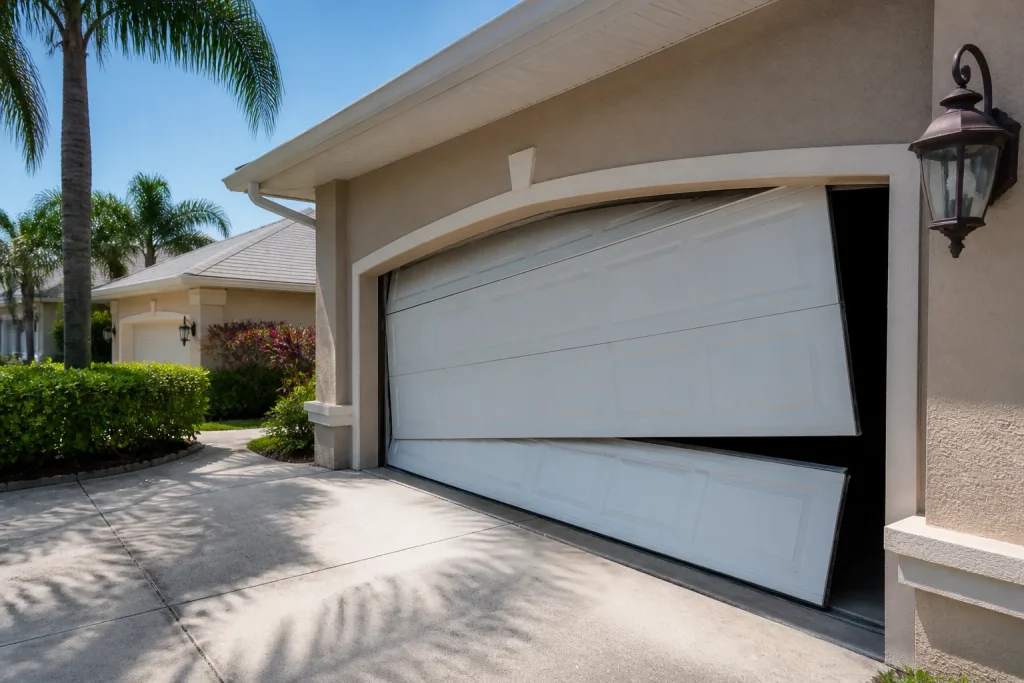
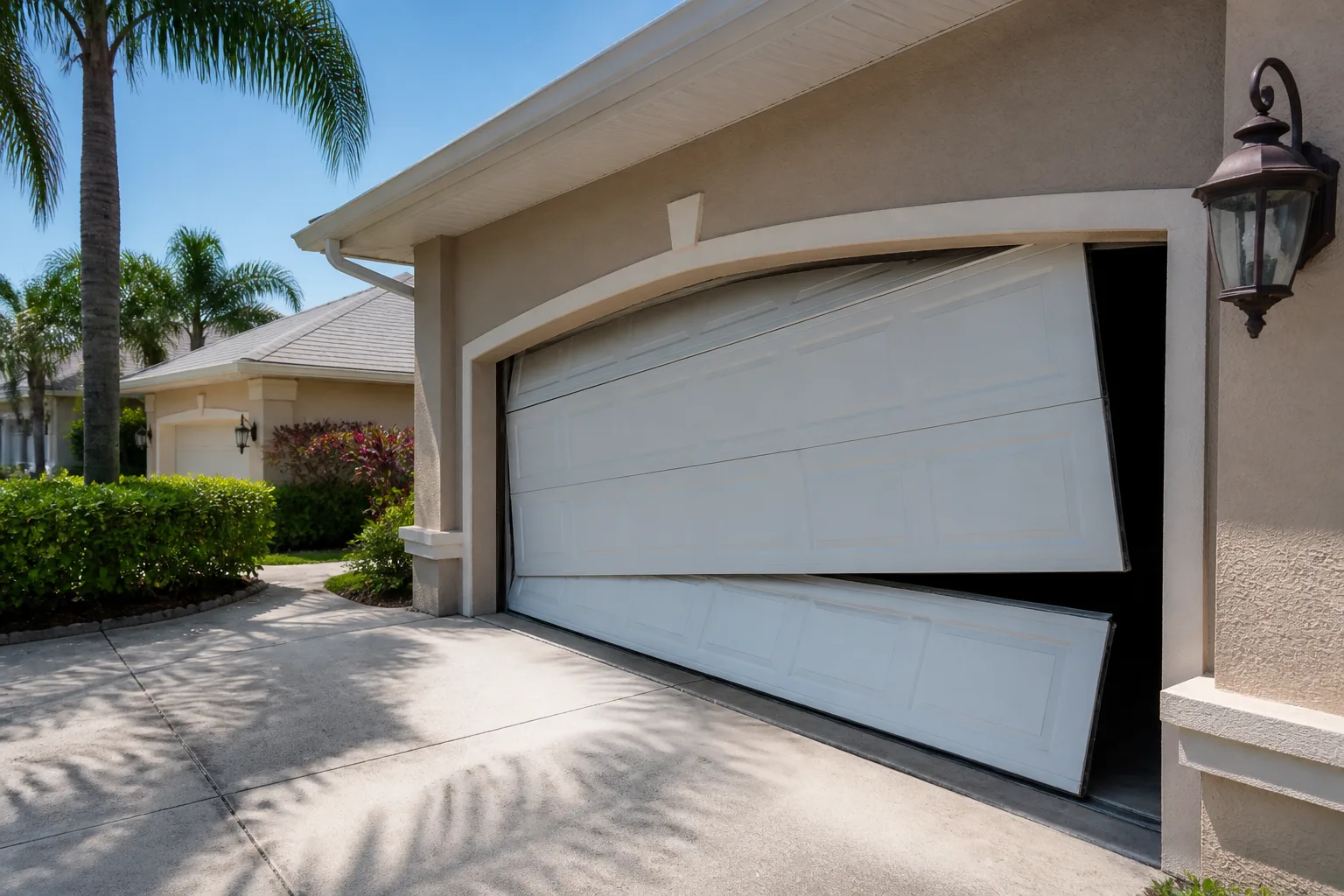
- A spring or cable has visibly broken or the door hangs unevenly.
- The door reverses or stops partway, every time.
- The door is stuck open, leaving the house unsecured.
Schedule within two weeks
- The door is noticeably slower or louder than it was, but still works.
- The balance test fails, or the door drifts when lifted.
- Grinding or squealing that’s new in the last month.
- Visible rust around hinges and rollers.
Address at your next annual service
- A single noisy hinge or roller.
- The bottom seal is starting to crack but the door runs smoothly.
- An opener remote with a weak battery.
- Paint fading on the door face, with no sign of rust underneath.
If the issue is a stuck door, a snapped spring, or a door that won’t secure the house, that’s our garage door installation and repair territory, and it’s the kind of call we handle as an emergency. When the door is still working but showing its age, the honest answer is often that the right fix is a new door rather than another round of repairs, and we’ll tell you which one we’d recommend in Clearwater.
Related services in Clearwater: we also handle spring replacement, opener repair, and new door installation as part of the same service. If you’re already working through a diagnosis, our garage door specialists can answer the follow-up questions in one call.
Our technicians have up to 11 years of experience with doors from every major manufacturer, including LiftMaster, Chamberlain, Genie, Clopay, Amarr, Wayne Dalton, Craftsman, and Raynor. That matters most when the fix is brand-specific and the wrong part just delays the next failure.
The Bottom Line
Garage door failures rarely happen without warning. They happen because slow operation, grinding noise, uneven travel, and a failed balance test get filed under “annoying but working.” The list above tells you which symptoms are early-stage mechanical failure and which can wait for service. Speed language aside, the balance test is the one check worth doing today. If you’re in Clearwater and need help, Clearwater Garage Door Repair Pros offers free estimates and emergency service for stuck or unsecured doors. Call (866) 488-2820. We answer 24/7. Fast dispatch from 7am to 7pm, Sunday through Friday.
Frequently Asked Questions
Slow or jerky operation is the most common sign, and it usually means spring tension loss or opener strain rather than an aging motor. If the door is also louder than it used to be, worn rollers are likely adding to the problem. Call (866) 488-2820 for a free estimate and we’ll confirm what’s causing it.
No. Torsion and extension springs are under heavy tension even when the door is closed, and a spring that slips during a homeowner adjustment can cause serious injury. Spring repair is a job for a trained technician, and this is the one part of the door where we recommend no DIY. Call (866) 488-2820 and we’ll take a look.
A well-maintained steel door typically lasts many years, but springs, rollers, and opener parts wear out well before the door does. That’s why routine visual inspection matters more than the door’s age. If your door is showing any of the symptoms above, call (866) 488-2820 for a free estimate.
Call today for a door that won’t move, a snapped spring or cable, a door that reverses every time, or a door stuck open and leaving the house unsecured. Schedule within two weeks for slow operation, new grinding, a failing balance test, or visible rust. When in doubt, call (866) 488-2820 and we’ll help you sort it out.
Written by the team at Clearwater Garage Door Repair Pros.
Need Garage Door Help?
Call Clearwater Garage Door Repair Pros - the local pro we connect you with is licensed and insured, here with fast help in Clearwater.
(866) 488-2820